Flow-Rate Sizing, May 2026
4 GPM Tankless Water Heater Cost in 2026
A 4 GPM tankless covers one shower plus one small fixture. Installed cost runs $400 to $1,400 in 2026, with electric models dominating the category and gas units virtually absent at this capacity tier.
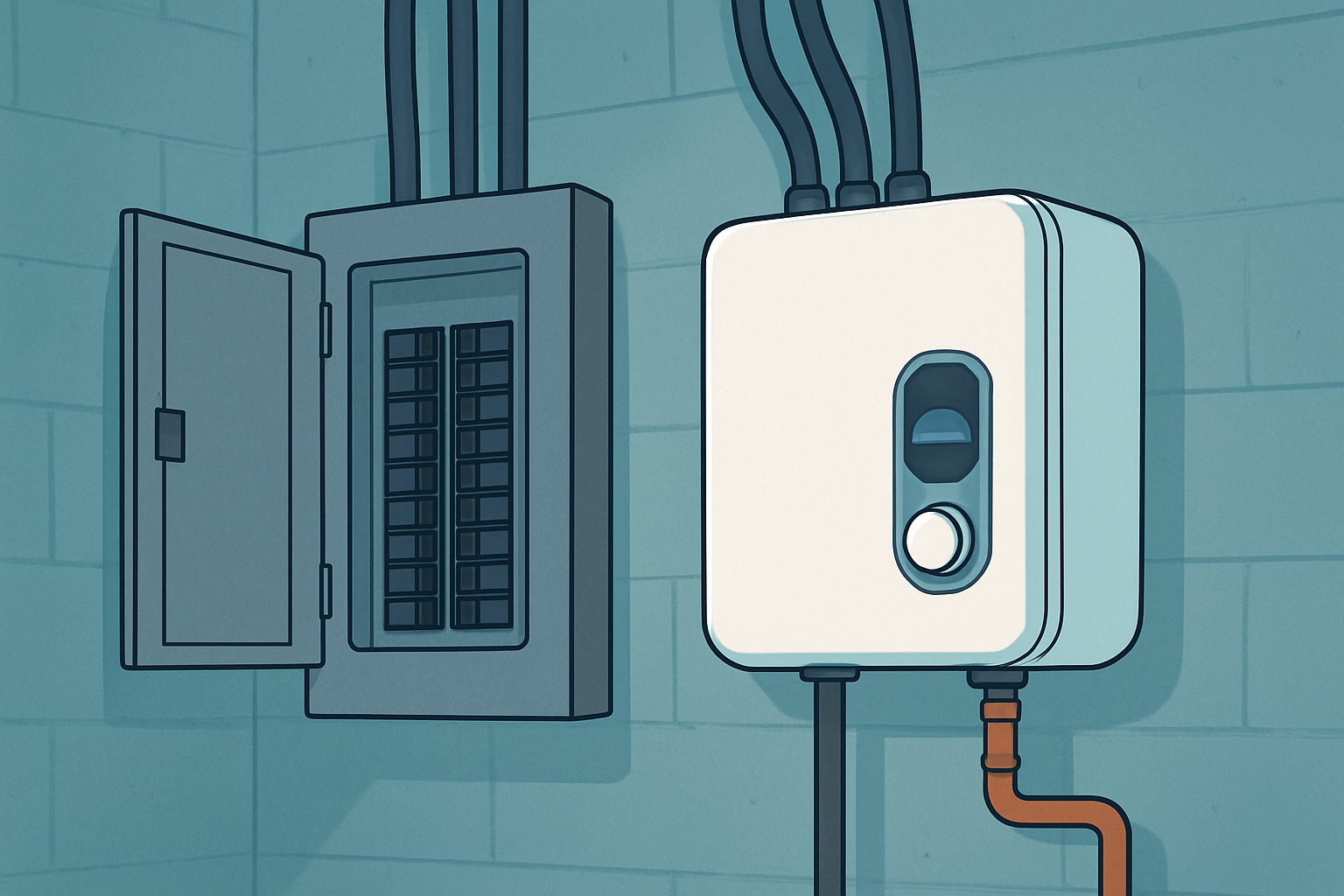
Right-sizing rule: 4 GPM is single-fixture-plus-trim, not whole-house. Most US homes outgrow this capacity by year 2 of ownership; size up if there is any path to a second bathroom.
What 4 GPM actually delivers in daily use
A gallon per minute is a measure of flow at a fixed temperature rise (typically 35F or 70F). At 4 GPM, you can run:
- One standard shower (2.0 to 2.5 GPM) plus a bathroom sink running half-flow (1.0 GPM) plus a slow-fill front-loader dishwasher (0.5 GPM)
- Or, one rain-head shower (3.0 GPM) plus a single tap on trim
- Or, two low-flow showers (1.8 GPM heads each) running simultaneously, if the heads are flow-restricted
What 4 GPM does not deliver: two standard-flow showers at the same time (needs 4 to 5 GPM minimum), a soaking tub fill (most are 6 to 8 GPM), or a typical washing-machine fill cycle running alongside a shower. The honest sizing question is "what is the worst-case simultaneous demand in this home" not "how big is the home".
Why 4 GPM is an electric-only category
Gas tankless units are built around a heat-exchanger geometry that gets less efficient as you turn them down. The minimum-fire setting on the smallest residential gas tankless on the US market (the Bosch Tronic 3000T) is around 11,000 BTU per hour. At a 35F rise, that minimum produces around 5 GPM. Below 5 GPM, the burner short-cycles, and short-cycling is the single biggest cause of premature heat-exchanger failure.
Electric tankless units have no minimum-fire constraint. They modulate from 0% to 100% of rated power continuously. A 24 kW electric unit (the standard "whole-house small" size) can deliver anywhere from 0.5 GPM to its rated 4 GPM at a 50F rise, then back down to 0.5 GPM, instantly. No short-cycling. No combustion. No vent.
The 4 GPM electric models worth quoting
Stiebel Eltron Tempra 24 Plus
The Stiebel Eltron Tempra 24 Plus is the long-running benchmark in this category. 24 kW power draw, 240V, 100A breaker. Rated 4.0 GPM at a 35F rise (perfect for FL inlet temps) and 2.4 GPM at a 70F rise (cold-climate winter). Unit cost: $700 to $900. Installed cost: $1,000 to $1,400, mostly determined by whether the electrical service can be tapped without a panel upgrade.
The Tempra's claim to fame is true PID modulation: it adjusts power output continuously to maintain a setpoint within plus-or-minus 1F. Most cheaper electric tankless units use bang-bang control with plus-or-minus 4F swings, which is noticeable in the shower.
EcoSmart ECO 24
The EcoSmart ECO 24 is the value play. Same 24 kW, 240V, 100A footprint as the Tempra but at $450 to $650 unit cost. Installed: $700 to $1,100. Sacrifices the PID modulation for simpler bang-bang control. Most users do not notice unless they have low-flow heads that exaggerate the temperature swing. Lifetime warranty on the heating elements, which is unusual at this price.
Bosch Tronic 6000
The Bosch Tronic 6000 sits in the middle on price ($550 to $750) and capability. 27 kW draw, 240V, 120A breaker. Rated 4.5 GPM at a 35F rise, 2.7 GPM at a 70F rise. Slightly more capacity than the Tempra/ECO 24 pair at marginally higher install cost. Worth considering if you are close to outgrowing the 4 GPM tier and want a bit of headroom.
Stiebel Eltron Mini-Plus point-of-use line
For under-sink or single-shower installs, the Stiebel Mini-Plus and Mini-Sink series run on 240V single-phase, 18 to 60 amp draws, deliver 0.5 to 1.5 GPM, and install for $250 to $600 total. Suitable for a remote bathroom or a guest cottage where running a hot-water line from the main heater would itself be expensive.
Itemised installed cost for a Stiebel Tempra 24 Plus
Suburban replacement scenario, existing 200A residential panel:
| Line item | Cost | Notes |
|---|---|---|
| Stiebel Tempra 24 Plus unit | $700 to $900 | Distributor price; Amazon often comparable |
| 100A double-pole breaker | $30 to $60 | If a slot is available in the panel |
| Wiring: 1/0 AWG copper, 20 ft run | $120 to $220 | Heavier gauge than most homes have spare |
| Panel upgrade (only if needed) | $0 to $2,200 | Most 200A panels handle 24 kW; older 100A panels do not |
| Water-line connections (3/4 in copper) | $60 to $140 | Existing connections usually re-used |
| Mounting hardware and labour, 2 to 4 hours | $200 to $500 | Electric tankless installs faster than gas |
| Permit and inspection | $50 to $200 | Electrical permit only; lower than gas |
| Old water heater removal | $60 to $120 | If applicable |
| Total (no panel upgrade) | $1,220 to $2,140 | Most common scenario |
| Total (with panel upgrade) | $2,420 to $4,340 | Older homes with 100A service |
The 4 GPM electric advantage over a 4 GPM gas unit is straightforward: where the cheapest gas option would be $2,200 to $3,400 installed (a Bosch Tronic 3000T or similar), the electric option lands at $1,200 to $2,100 without a panel upgrade. The crossover threshold is the panel: if you need a panel upgrade, gas often wins on installed cost even though gas has a higher unit price.
Why climate is the dominant variable
An electric tankless unit's GPM rating is always tied to a specific temperature rise. The 4 GPM rating on a Stiebel Tempra 24 is at a 35F rise. That means if the incoming municipal water is 80F (Miami in summer), it delivers 4 GPM at 115F output, which is too hot to shower in (you would mix in cold). If the incoming is 45F (Boston in February), the same unit only manages 2.4 GPM at the same 35F rise.
The DOE sizing guide publishes regional inlet-temperature ranges that drive this calculation. In practice:
| Region | Winter inlet | Tempra 24 winter GPM | Summer GPM |
|---|---|---|---|
| Southern FL, southern TX | 65 to 75F | 4.0+ GPM | 4.0+ GPM |
| Mid-Atlantic, southern CA | 50 to 60F | 3.0 GPM | 4.0 GPM |
| Midwest, northern CA | 40 to 50F | 2.4 GPM | 3.5 GPM |
| New England, upper Midwest | 35 to 45F | 2.0 GPM | 3.0 GPM |
| Mountain West (high altitude) | 32 to 42F | 1.8 GPM | 3.0 GPM |
The lesson: a 4 GPM unit in Miami is a different machine from a 4 GPM unit in Minneapolis. If you live in a cold climate and you have any chance of a second bathroom, do not buy a 4 GPM unit. Step up to 6 or 7 GPM in cold climates.
Federal tax credit: ended for 2026 installs
The IRS Section 25C credit (30% of installed cost, capped at $600 per tax year for tankless) ended for any unit placed in service after December 31, 2025, under the One Big Beautiful Bill Act. A 2026 install gets no federal credit. If your unit was installed during 2025, you can still claim it on your 2025 return via IRS Form 5695.
Annual operating cost vs a 40-gallon tank electric
A typical 40-gallon electric tank heater consumes around 4,000 kWh per year for a 2-person household. A 4 GPM electric tankless for the same household consumes around 3,200 to 3,400 kWh per year (15% to 20% savings from eliminating standby heat loss). At the US average residential electric rate of $0.17 per kWh (per EIA monthly residential rates), that is an annual saving of $100 to $135. Payback on a $400 to $700 incremental cost over a tank install is 4 to 7 years.
Bottom line
4 GPM is the right capacity for one-bedroom apartments, small studios, mother-in-law suites, and guest cottages in warm climates. It is almost always an electric tankless install in 2026, with the Stiebel Tempra 24 Plus and EcoSmart ECO 24 covering 80% of the market. Installed cost without a panel upgrade is $1,200 to $2,100. Add another $1,200 to $2,200 if the panel needs upgrading to handle the 100A continuous draw.
For 2-bath family homes, look at 6 or 7 GPM instead. The capacity ceiling on a 4 GPM unit becomes obvious the first time two people try to shower in the morning.
Related sizing and cost pages
Frequently asked questions
How much does a 4 GPM tankless water heater cost?
A 4 GPM tankless costs $400 to $1,400 installed in 2026. Electric models dominate this capacity range (Stiebel Eltron, EcoSmart, Bosch) because gas tankless units rarely go below 6 GPM. The bare unit is $250 to $750; installation is $150 to $650 depending on whether existing wiring is in place.
Is 4 GPM enough for a whole house?
4 GPM covers one shower running by itself, or a shower and a low-flow fixture (a bathroom tap or a slow-fill dishwasher) at the same time. It is enough for a one-bedroom apartment, a small studio, or a guest cottage. It is not enough for two simultaneous showers, which need 4 to 5 GPM minimum just for the showers. For a 2-bath family home, step up to 6 or 7 GPM.
Why are 4 GPM units almost all electric?
Gas tankless units have a minimum-fire BTU floor that makes producing only 4 GPM commercially awkward. The smallest gas tankless on the US market (Bosch Tronic 3000T) runs 5 GPM as its lowest setting. Below that demand, electric is more efficient and considerably cheaper to install, because there is no gas line, no vent, no condensate drain, and no permit overhead.
What climate works with a 4 GPM electric tankless?
Warm-water climates (FL, southern TX, southern CA, AZ) where the incoming municipal water sits at 65F or warmer year-round. In those conditions, a 24 kW electric unit reliably delivers 4 GPM at a 50F rise (output 115F). In cold climates where the inlet drops to 40F in winter, the same unit delivers only 2.5 GPM. Climate matters more than household size for electric tankless sizing.
Can a 4 GPM electric tankless run on a standard 120V outlet?
No. A 4 GPM electric whole-house tankless draws 24 kW at 240V (100 amps continuous). That is a dedicated double-pole 100A breaker, 1/0 AWG copper feeder, and a 240V circuit. A standard 120V 15A outlet delivers 1.8 kW, barely enough to warm 0.3 GPM. Point-of-use 120V tankless (like the Bosch Tronic 3000) exists but only delivers 0.5 to 1.0 GPM, suitable for a single bathroom sink.