Fuel-Specific Pricing, May 2026
Electric Tankless Water Heater Install Cost in 2026
Electric tankless splits cleanly into point-of-use installs (cheap, common, low-risk) and whole-home installs (cheap unit, expensive electrical infrastructure). Installed cost runs $800 to $2,800 without a panel upgrade, jumping to $2,000 to $4,500 when the panel needs upgrading.
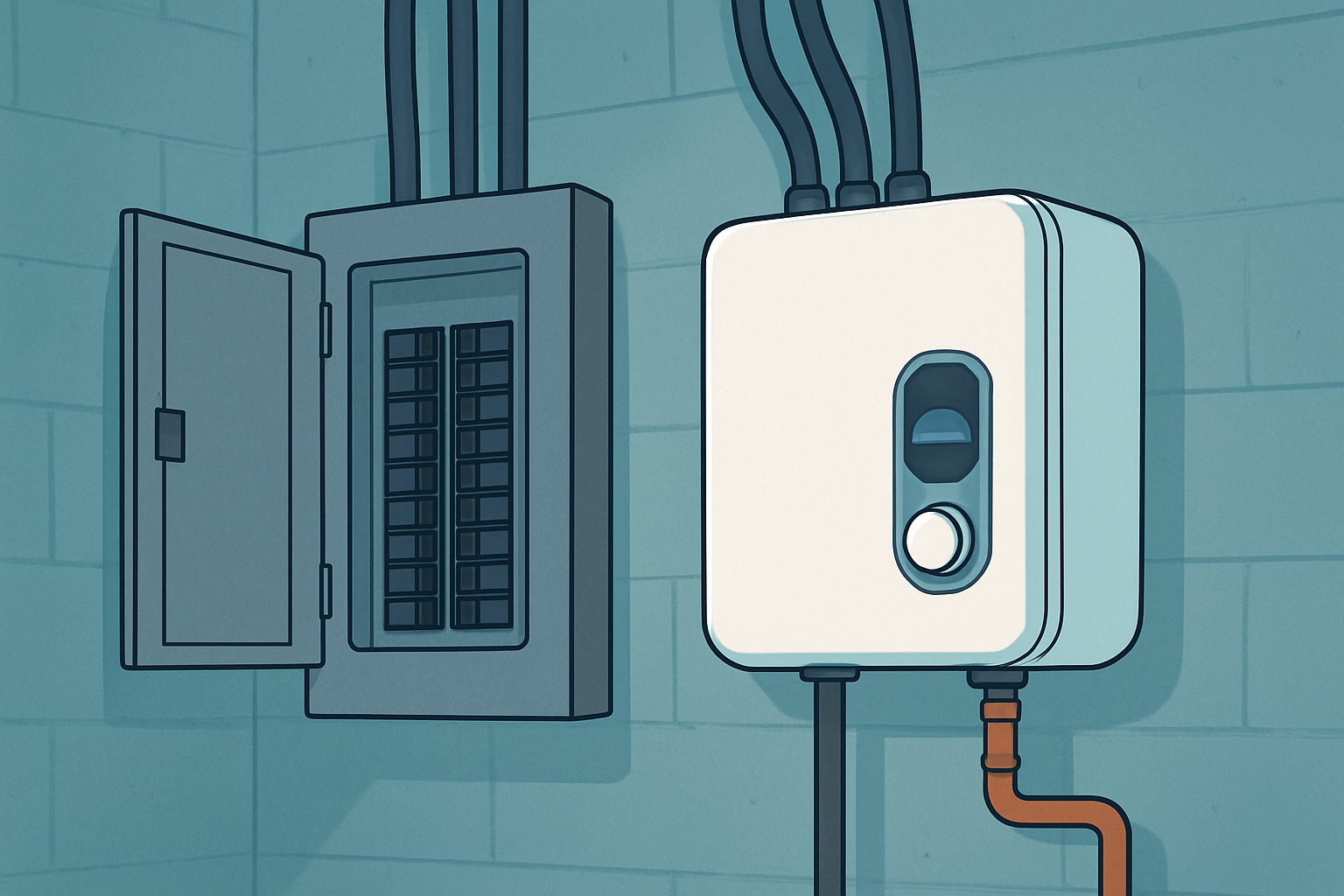
The panel question: if your home has 200A service and a panel with spare slots, whole-home electric tankless is straightforward. If your home has 100A service or a full panel, the panel upgrade alone costs more than the tankless unit. Check the panel before falling in love with electric.
Two distinct categories: point-of-use vs whole-home
Electric tankless is misleadingly marketed as one category. In practice, the install economics, the use cases, and the failure modes are completely different between point-of-use (POU) and whole-home units.
Point-of-use (POU): the easy, cheap install
A POU unit installs under a single sink, in a remote bathroom, or at a workshop wet station. Typical specs:
- 120V or 240V single-phase
- 15A to 60A breaker draw
- 0.5 to 1.5 GPM output
- Unit cost $80 to $400
- Install cost $150 to $500 (electrical hookup, water lines, wall mount)
- Total installed: $230 to $900
POU is the right answer for a remote bathroom 60 ft from the main water heater (where standing waste alone could be a gallon every time someone washes their hands), a guest cottage, a garage workshop, or any single-fixture install where running a hot-water line back to a central heater would itself be expensive.
Whole-home electric tankless: the complicated install
A whole-home electric unit replaces the central water heater for the entire house. Typical specs:
- 240V single-phase
- 80A to 150A continuous breaker draw (typically split across two or three breakers)
- 3 to 8 GPM output (climate-dependent)
- Unit cost $450 to $1,200
- Install cost $350 to $3,500 (highly variable based on panel work)
- Total installed: $800 to $4,700
The wide range is almost entirely the electrical infrastructure question. A home with 200A service and a panel with spare slots is at the low end. A home with 100A service, a full panel, and an old service drop is at the high end.
The whole-home electric tankless models worth quoting
Stiebel Eltron Tempra Plus series (24, 29, 36 kW)
The Stiebel Eltron Tempra Plus is the benchmark whole-home electric tankless. PID modulation, plus-or-minus 1F temperature stability, German engineering. The Tempra 24 Plus draws 100A, the Tempra 29 Plus draws 120A, the Tempra 36 Plus draws 150A. Unit prices $700 to $1,200. Installed cost $1,000 to $3,500 depending on panel work.
EcoSmart ECO series (18, 24, 27, 36 kW)
EcoSmart is the value play. Same kW ratings and amp draws as the Tempra equivalents, simpler bang-bang temperature control, lifetime element warranty. Unit prices $400 to $750. Installed cost $700 to $3,000.
Rheem RTEX series (13, 18, 24, 27 kW)
Rheem's electric tankless line, distributed through Home Depot. PID modulation, comparable to Stiebel. Unit prices $500 to $900. Installed cost $850 to $3,100.
Bosch Tronic 6000 series
Bosch's whole-home electric line, sized 18 to 27 kW. Slightly more capacity than the Tempra at marginally higher install cost. Unit prices $550 to $850. Installed $900 to $3,100.
Itemised installed cost: Stiebel Tempra 24 Plus, no panel upgrade
3-bath suburban home with 200A panel and a spare double-pole slot, retrofit from a 50-gallon electric tank:
| Line item | Cost | Notes |
|---|---|---|
| Tempra 24 Plus unit | $700 to $900 | Distributor or Amazon |
| 100A double-pole breaker | $30 to $60 | Drop-in to existing panel |
| Wiring: 1/0 AWG copper, 20 ft run | $120 to $220 | Heavier gauge than most homes carry spare |
| Water-line connections (3/4 in copper) | $60 to $140 | Existing connections reused |
| Mounting hardware | $30 to $80 | Wall bracket included with unit on some models |
| Labour, 3 to 5 hours | $300 to $700 | Faster than gas install |
| Permit and inspection | $50 to $200 | Electrical permit only |
| Old water heater removal | $60 to $120 | If applicable |
| Total installed | $1,350 to $2,420 | 200A panel scenario |
Itemised installed cost with a panel upgrade
Same Tempra 24 Plus install in a home with existing 100A service requiring an upgrade to 200A:
| Line item | Cost | Notes |
|---|---|---|
| Tempra 24 Plus unit | $700 to $900 | Same as above |
| 200A service panel upgrade | $1,200 to $2,200 | New panel, new feeder, new meter base |
| Utility service drop coordination | $0 to $400 | Typically free in metros, billable in rural |
| 100A double-pole breaker for tankless | $30 to $60 | Part of new panel scope |
| Wiring: 1/0 AWG copper, 20 ft run | $120 to $220 | Same as above |
| Water-line connections | $60 to $140 | Same |
| Mounting hardware | $30 to $80 | Same |
| Labour, 8 to 14 hours (electrician + plumber) | $800 to $1,800 | Longer than non-upgrade scenario |
| Permit and inspection | $150 to $400 | Higher because of panel scope |
| Old water heater removal | $60 to $120 | Same |
| Total installed | $3,150 to $6,320 | Panel upgrade scenario |
This is the scenario where electric tankless economics break down. A $3,000 to $6,000 install is more expensive than an equivalent gas tankless install where natural gas is available. Make the panel-capacity check before the equipment choice.
Why climate is the dominant capacity variable
Electric tankless capacity is rated at a specific temperature rise (typically 50F). Cold-climate winter inlet temperatures cut effective output by 30% to 40%. A Tempra 24 Plus delivers:
- 4.0 GPM at 50F rise (75F inlet to 125F output): summer FL
- 3.3 GPM at 60F rise (65F inlet to 125F output): winter FL or summer northern US
- 2.7 GPM at 75F rise (40F inlet to 115F output): winter MN, NY, ME
- 2.4 GPM at 85F rise (32F inlet to 117F output): winter Mountain West high altitude
In a cold-climate winter, a 4 GPM rated unit delivers what a 2.5 GPM unit delivers in summer. That is the difference between adequate-for-one-shower and inadequate-for-one-shower. If you live in a cold climate, the rule of thumb is to upsize one kW tier above what the spec sheet suggests: a Tempra 29 (120A) in cold climates where the spec sheet says a Tempra 24 (100A) would suffice. The cost premium is real (a 200A panel becomes more necessary) but the alternative is cold showers in February.
Federal tax credit: ended for 2026 installs
The IRS Section 25C credit (30% of installed cost, capped at $600 per tax year for tankless) ended for any unit placed in service after December 31, 2025, under the One Big Beautiful Bill Act. A 2026 install gets no federal credit. If your unit was installed during 2025, you can still claim it on your 2025 return via IRS Form 5695.
Where heat-pump water heaters compete
Heat-pump water heaters (HPWH) deserve a mention because they compete directly with electric tankless. An HPWH uses 60% less electricity than an electric tank for the same hot-water output, qualified for a higher 25C credit cap while the credit ran ($2,000 vs $600 for tankless; both ended December 31, 2025), and works without the panel upgrade headache because they typically draw 15 to 30A continuous.
The trade-off: HPWHs are tank-style (60 to 80 gallon footprint), produce some cooling and humidity in the install space (a feature in basements, a bug in living spaces), and take 5 to 8 hours to recover a depleted tank. For a household where standby loss is the operating cost driver, HPWH usually wins on lifecycle economics; for households where unlimited on-demand hot water is the priority, electric tankless still has a use case.
Bottom line
Electric tankless is the right choice for point-of-use installs (under a remote sink, in a guest cottage, at a workshop) and for whole-home installs in warm-climate, well-electrified homes. Installed cost is $230 to $900 for POU, $800 to $2,800 for whole-home without a panel upgrade, and $2,000 to $4,500 with a panel upgrade.
In cold climates, electric tankless struggles to keep up with realistic winter demand. In any home where natural gas is available, gas tankless usually wins on installed cost, operating cost, and capacity. The honest moment of decision is the panel check: if it needs upgrading, the economics often swing toward gas (where available) or a heat-pump tank.
Related pricing pages
Frequently asked questions
How much does an electric tankless install cost?
An electric whole-home tankless installs at $800 to $2,800 without a panel upgrade. The bare unit is $450 to $1,200; installation is $350 to $1,600 mostly determined by how much electrical work is needed. If the existing 100A or 150A electrical panel cannot accommodate a 100A or 120A continuous-draw breaker, add $1,200 to $2,200 for a panel upgrade. Point-of-use under-sink units install at $250 to $700 total.
Why is the price range so wide?
Two reasons: panel capacity and wire run length. A whole-home electric tankless needs 100A to 150A of continuous current at 240V, which is more than many older homes have spare on the panel. A panel upgrade from 100A service to 200A service costs $1,200 to $2,200 in 2026 (per the Bureau of Labor Statistics electrician wage series and standard parts pricing). The wire run from panel to heater needs heavy-gauge copper (1/0 to 3/0 AWG), which costs $5 to $12 per foot installed.
Do electric tankless heaters work in cold climates?
Marginally. The spec sheet GPM rating is at a 50F temperature rise. In cold climates where the incoming water sits at 40F in winter, you need a 75F rise to reach 115F shower temperature. Effective capacity drops 30% to 40% in winter. A unit rated 4 GPM in summer delivers 2.5 GPM in February. For whole-home use in MN, ME, or upstate NY, gas tankless is realistically the only option unless you accept slower fills.
Is there a federal tax credit for electric tankless in 2026?
No. The Section 25C credit (30% of cost capped at $600 for tankless) ended for any unit placed in service after December 31, 2025, under the One Big Beautiful Bill Act. Units installed during 2025 that met the ENERGY STAR Most Efficient threshold can still be claimed on the 2025 return via IRS Form 5695. While the credit ran, several Stiebel Eltron, EcoSmart, and Rheem whole-home models qualified; point-of-use units typically did not because they fell below the whole-home demand threshold ENERGY STAR uses.
Is electric tankless cheaper to operate than electric tank?
Yes, by 15% to 20% annually, by eliminating standby heat loss. A 50-gallon electric tank consumes around 4,500 kWh per year for a 4-person household. An electric tankless serving the same household consumes around 3,600 to 3,800 kWh. At the US average residential rate of $0.17 per kWh, the savings are $120 to $150 per year. Payback on the install premium is typically 5 to 9 years.