Add-On Pricing, May 2026
Recirculation Pump for Tankless Water Heater Cost in 2026
Adding instant-hot-water recirculation to a tankless install adds $200 to $1,200 in 2026, depending on whether you use comfort-mode (cheap, less perfect), dedicated-loop (expensive, best), or built-in (cheapest if you are doing a new install).
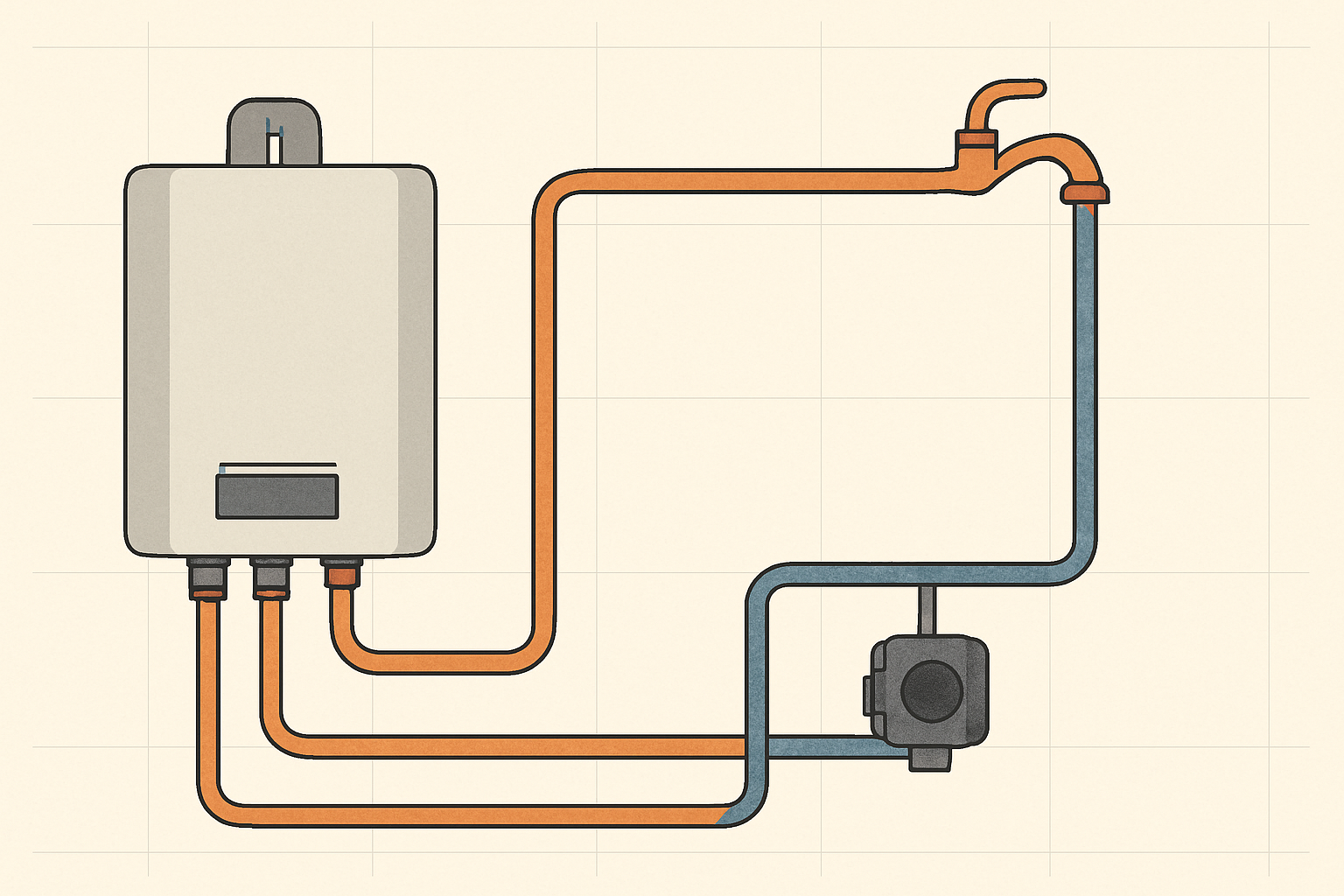
The waste a recirculation pump solves: a typical 4-person household with no recirculation wastes 8,000 to 16,000 gallons a year waiting for hot water at distant fixtures. A $600 aftermarket install pays back in 3 to 6 years on water savings alone.
Why tankless needs recirculation more than a tank heater
A tank-style water heater stores 40 to 80 gallons of pre-heated water. When you open a hot tap, you get hot water at the heater immediately and at the fixture after the standing cold water in the supply line is flushed out (typically 1 to 2 gallons of waste).
A tankless unit produces hot water on demand: when you open a tap, the unit detects flow, ignites the burner, and within 5 to 10 seconds is delivering hot water. But the supply line between the heater and the fixture is still full of cold water. You wait for that cold water to be flushed out plus the 5 to 10 seconds of unit-warm-up time. Distant fixtures wait 15 to 45 seconds for hot water, plus 1 to 3 gallons of waste per draw.
Recirculation solves this by keeping the hot-water supply line hot at all times (or at least when the household is awake and active). When you open a tap, hot water is already at the fixture; the wait drops to under 3 seconds and the waste drops to less than half a gallon.
Three recirculation architectures, three price points
Comfort-mode recirculation ($200 to $500 install)
Comfort-mode uses the cold-water line as a return path. A thermostatic crossover valve (called a Smart Recirculation Valve or Comfort Valve) is installed under the sink at the farthest fixture. When water temperature in the hot line drops below about 95F, the valve opens, letting hot water flow into the cold line; the pump pushes hot water through the loop. When the hot line warms back up, the valve closes.
The downside: the cold-water line at fixtures on the same loop is briefly warm (60 to 85F) during recirculation cycles. Some users find this annoying; most do not notice. For ice-cube production from cold tap water, it is a minor issue (let the tap run for 10 seconds before filling the ice tray).
Components: $100 to $200 Grundfos UP15 or Taco SmartPlug pump, $80 to $180 crossover valve, $20 to $80 timer or schedule controller, plus install labour at $200 to $300 if you have to extend an electrical outlet to the pump.
Dedicated-loop recirculation ($800 to $1,500 install)
A dedicated-loop install runs a separate 1/2 inch or 3/4 inch return line from the farthest fixture back to the heater's recirculation port (or to a tee on the cold-water side). The pump pushes hot water through this loop. No crossover valve; no cold-line warming.
The downside: the cost of running the return line. In an existing finished house with closed walls and ceilings, this often means a $400 to $700 plumbing run through unfinished basements, attics, and access panels. In new construction, the return line is run at framing time at marginal cost.
Components: $200 to $400 pump (Grundfos UP15 or Taco Comfort System or similar), $400 to $1,000 plumbing for the return line, $100 to $300 controller and electrical. Higher-end smart systems (Aquanta, FloLogic) add Wi-Fi monitoring and motion-activated triggering for another $200 to $500.
Built-in pump (Navien NPE-A2, Noritz NRCP, Rinnai RX) ($200 to $500 premium)
Several tankless models include the recirculation pump and a small buffer tank inside the heater cabinet. The pump engages on a programmable schedule or on-demand (via a wireless button at the fixture or a motion sensor). This is the cleanest install option because the pump is factory-integrated, warranty-covered, and never short-cycles the heater the way an aftermarket pump can.
The Navien NPE-240A2 with ComfortFlow costs $200 to $400 more than the NPE-240S2 without it. The Noritz NRCP1112-DV costs $300 to $500 more than the EZ111-DV. The Rinnai RX180iN costs $400 to $600 more than the RU180. All built-in options are cheaper than adding an equivalent aftermarket pump on a non-recirc unit.
Itemised cost comparison: aftermarket on existing tankless
Existing Rinnai RU160iN without recirculation; adding a Grundfos UP15-10 pump and Watts crossover valve, comfort-mode install:
| Line item | Cost | Notes |
|---|---|---|
| Grundfos UP15-10 pump | $140 to $200 | Bronze-bodied 1/3 horsepower |
| Watts Hot Water Recirc Crossover valve | $80 to $140 | Thermostatic, no power needed at valve |
| Pump timer or schedule controller | $40 to $120 | Optional: smart Wi-Fi controller |
| Plumbing: tees, isolation valves, fittings | $80 to $160 | 1/2 inch PEX or copper |
| Electrical: outlet for pump within reach | $0 to $200 | If existing outlet, $0; if not, $150 to $200 |
| Labour: 2 to 4 hours | $180 to $500 | Plumber labour rate |
| Total installed | $520 to $1,320 | Most installs land $600 to $900 |
Itemised cost comparison: built-in on new tankless install
Choosing Navien NPE-240A2 (with ComfortFlow) instead of NPE-240S2 (without):
| Line item | Without recirc (NPE-S2) | With recirc (NPE-A2) | Premium |
|---|---|---|---|
| Tankless unit | $1,500 to $1,800 | $1,800 to $2,200 | $300 to $400 |
| Additional electrical for pump | $0 | $50 to $100 | $50 to $100 |
| Dedicated return line (optional) | $0 | $0 to $400 | $0 to $400 |
| Labour difference | baseline | +1 hour | $90 to $130 |
| Premium for built-in recirc | - | - | $440 to $1,030 |
Compare with aftermarket (above): built-in is roughly $150 to $400 cheaper than the equivalent aftermarket addition on a non-recirc unit. If you are doing a fresh install, the built-in option is the clear winner. If you already have a non-recirc tankless and are retrofitting recirculation, aftermarket is your only option.
Pumps worth specifying by brand
Grundfos UP15 series
The Grundfos UP15 Comfort series is the industry-standard aftermarket recirculation pump. Bronze-bodied (potable-water rated), three speeds, around 25 watts continuous draw. UP15-10 is the standard residential model; UP15-29 for larger homes. Unit cost $140 to $260. Service life 15 to 20 years. Warranty 5 years.
Taco SmartPlug series
The Taco 006B-BC Smart Recirc Plug is the value alternative to Grundfos. Same bronze body, slightly less efficient motor, 5-year warranty. Unit cost $100 to $180.
Watts Premier (the budget pump)
The Watts Premier Hot Water Recirc System is sold as a kit at Home Depot for $150 to $250, including the pump, the crossover valve, and basic plumbing fittings. Suitable for DIY install on a Saturday afternoon. Lower motor quality than Grundfos or Taco; service life 5 to 8 years.
Built-in pumps in tankless units
Navien NPE-A2 ComfortFlow, Noritz NRCP-DV ETO, Rinnai RX180iN, and a handful of Rheem RTGH-RXLN models include factory-integrated pumps. All are smarter than aftermarket pumps (they coordinate pump cycles with burner cycles to minimise short-cycling) but you cannot replace just the pump if it fails; you replace the whole unit. Most last 10 to 14 years in field use.
Energy cost of running a recirculation pump
A continuously-running 25 watt pump consumes 219 kWh per year, costing $37 at the US average residential rate. A scheduled pump (running 4 hours per day) consumes 36 kWh per year, $6. An on-demand pump (running only when triggered by a button or motion) consumes 1 to 2 kWh per year, less than $1.
The bigger operating cost is the additional gas burner cycles caused by maintaining the loop at temperature. A continuously-running pump increases tankless gas consumption by 8% to 15% (around $25 to $50 per year extra in fuel). A scheduled or on-demand pump adds 2% to 5% ($5 to $15 per year).
Net: a scheduled or on-demand pump costs $10 to $25 a year extra in operating cost. A continuously-running pump costs $60 to $90 a year extra. For most households, scheduled or on-demand is the right balance of comfort and cost.
When recirculation is not worth it
Three scenarios where the recirculation install does not pay back:
- The tankless is mounted within 10 ft of the master bath. Waste is already under 0.5 gallons per draw; recirculation barely improves it.
- One-person household with low daily hot-water demand. The energy cost of running the pump can exceed the value of the water saved.
- Vacation home used 4 weekends a year. The pump runs all year for 4 weekends of comfort; not worth the operating cost.
Bottom line
For most US homes with a tankless installed in a basement, garage, or utility closet remote from the main bathrooms, a recirculation pump pays back in 3 to 6 years on water savings alone. The cheapest path is a built-in pump on a new tankless install (Navien NPE-A2 is the value leader). The next cheapest is comfort-mode retrofit on an existing tankless ($500 to $900 installed). Full dedicated-loop recirculation is the gold standard but only justifies its $1,000 to $1,500 cost in larger homes with multiple far-flung fixtures.
Related cost and feature pages
Frequently asked questions
How much does it cost to add a recirculation pump to a tankless install?
Adding a recirculation pump to a tankless install costs $200 to $1,200 in 2026. The lower end ($200 to $400) is comfort-mode using the existing cold-water line as a return; the upper end ($800 to $1,200) is a full dedicated return loop with a 240V smart pump and crossover valves. The cheapest option is buying a tankless model with a built-in pump (Navien NPE-A2 or Noritz NRCP), where the pump is included in the unit at a $200 to $500 premium over the equivalent non-recirc model.
What is the difference between dedicated-loop and comfort-mode recirculation?
A dedicated-loop recirculation runs a separate hot-water return line from the farthest fixture back to the heater. The pump pushes hot water through this loop continuously or on a schedule. Comfort-mode (also called crossover or under-sink mode) uses the cold-water line as the return path, with a thermostatic crossover valve at the farthest fixture that opens until the water reaches 95F. Dedicated-loop delivers instant hot water at every fixture; comfort-mode delivers instant hot water at the fixture with the valve and slightly warm cold water at all other fixtures on the same line.
Is the cost of a recirculation pump worth it?
For most US homes, yes. Without recirculation, a typical 4-person household wastes 8,000 to 16,000 gallons of water a year waiting for hot water at distant fixtures. At average US water-and-sewer rates ($12 per 1,000 gallons), that is $96 to $192 a year. A $600 aftermarket pump install pays back in 3 to 6 years on water savings alone, faster if you value not waiting.
Which is cheaper: built-in or aftermarket recirculation?
Built-in is cheaper if you are installing a new tankless. A Navien NPE-A2 with built-in ComfortFlow costs $200 to $500 more than the non-recirc NPE-S2 of the same capacity. An aftermarket Grundfos UP15 plus install on a non-recirc unit costs $400 to $800. The built-in option also avoids the future maintenance cost of a separate pump (typically a $200 to $400 service event in year 9 to 12). If you are adding recirculation to an existing tankless that does not have it, aftermarket is your only option.
Does a recirculation pump shorten tankless lifespan?
Slightly. A continuous-cycle pump causes the tankless to short-cycle on small hot-water draws (the pump triggers a 10-second burn cycle every 90 seconds or so when running), which causes more wear on the heat exchanger than infrequent long burns. The effect is real but small. A scheduled or on-demand pump (running only at peak hours, or only when motion is detected near a fixture) eliminates most of the short-cycling penalty. Most modern tankless units with built-in pumps default to on-demand mode for this reason.