Conversion Scenario, May 2026
Tank to Tankless Conversion Cost in 2026
The single most common tankless install scenario in the US: a homeowner whose 12-year-old tank water heater is failing decides to upgrade to tankless instead of swapping in another tank. Conversion costs run $2,800 to $5,500 in 2026, a $1,500 to $2,500 premium over a like-for-like tank replacement.
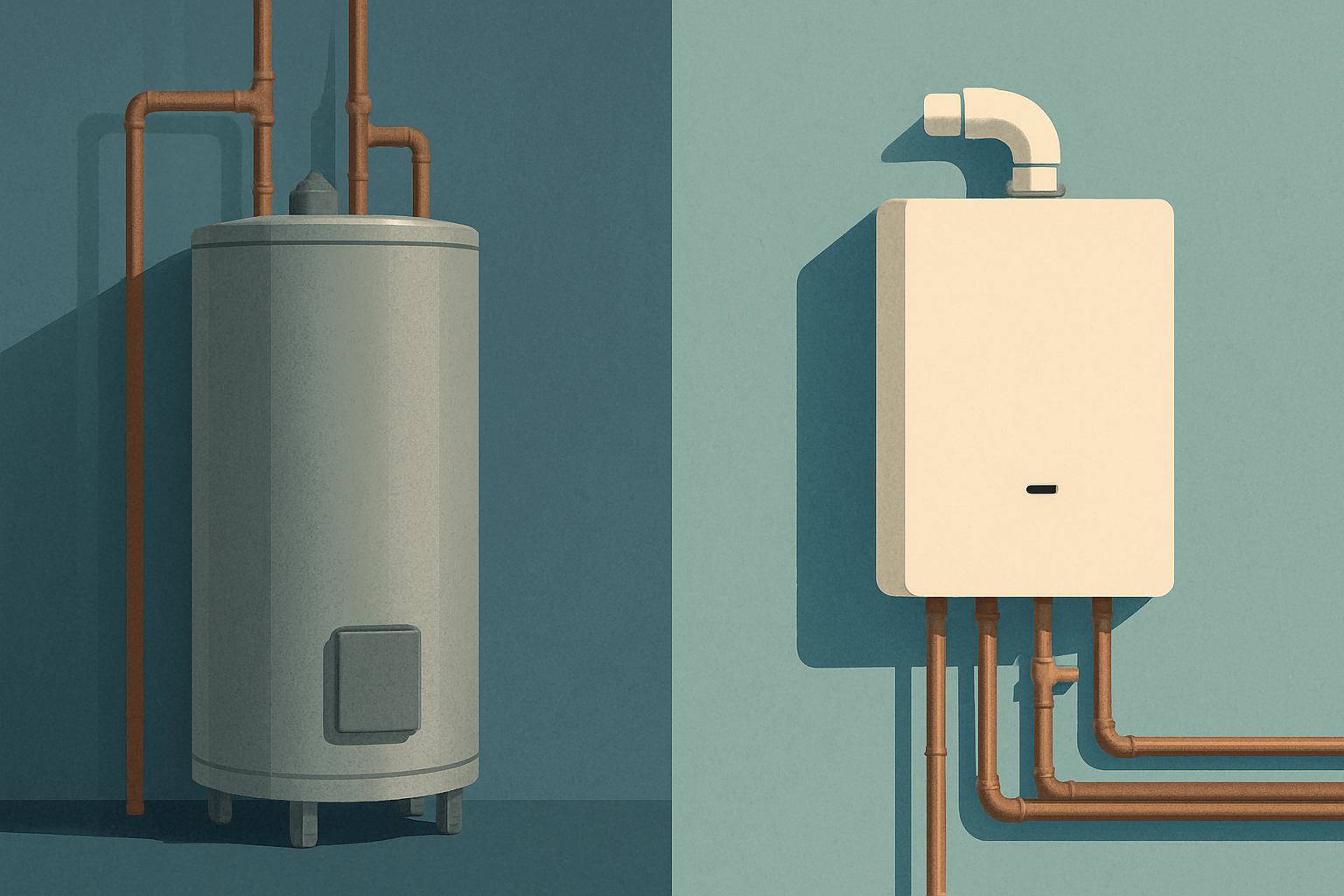
The conversion premium, summarised: $500 to $1,000 gas line, $300 to $700 vent, $100 to $300 condensate, $400 to $800 higher unit cost, $200 to $400 extra labour. Total premium: $1,500 to $3,200 above a tank swap. Recovered through lower operating cost and the avoided second tank replacement at year 12.
Why a conversion costs more than a like-for-like swap
A tank-to-tank swap is the simplest plumbing job in the residential market: 2 to 4 hours of work, mostly re-using existing infrastructure (gas line, vent, water connections, electrical for controls if any). The total bill is typically $1,200 to $2,000.
A tank-to-tankless conversion adds five distinct scope items that the tank swap does not need, each costing money:
- Gas line resize ($500 to $1,000). A 50-gallon gas tank fires at 40,000 to 80,000 BTU per hour. A whole-house tankless fires at 150,000 to 199,000 BTU per hour. The 1/2 inch gas line that fed the tank cannot deliver enough fuel to the tankless without exceeding the maximum pressure drop allowed by NFPA 54 / IFGC code. The fix is running 3/4 inch black-iron or CSST from the meter to the heater location. Cost varies with run length (most are 20 to 40 ft, costing $20 to $35 per ft installed).
- New dedicated venting ($300 to $700). The tank's 3 inch or 4 inch B-vent (a single-wall flue terminating through the roof) cannot be re-used for a condensing tankless. Condensing exhaust is near room temperature and contains acidic water vapour that corrodes a B-vent quickly. The replacement is typically a concentric stainless or PVC vent terminating through an exterior wall. PVC is cheaper but only works with condensing units that keep exhaust temperature below 140F.
- Condensate drain and neutraliser ($100 to $300). A condensing tankless produces 1 to 2 gallons of slightly acidic water condensate per day. Code requires this to drain through a neutraliser cartridge (calcium carbonate, $40 to $80) into a floor drain or condensate pump. The tank heater produced no condensate.
- 120V electrical circuit ($100 to $300). Tankless units need a dedicated 120V outlet near the heater for the controls and ignition. Most older tank-heater locations do not have one within 6 ft. Either a short circuit extension from a nearby outlet or a new home-run from the panel.
- Isolation valves and flush ports ($80 to $160). Manufacturer warranties require these. Tank heaters do not need them.
Itemised conversion cost: tank-style 50 gal to Rinnai RU160iN
3-bath suburban home, 2010-vintage 50-gallon gas tank failing, conversion to a Rinnai RU160iN on natural gas:
| Line item | Tank swap | Tankless conversion | Premium |
|---|---|---|---|
| Unit (50 gal tank vs RU160iN) | $700 to $1,100 | $1,500 to $1,900 | $800 to $800 |
| Gas line work | $0 (re-use) | $500 to $1,000 | $500 to $1,000 |
| Venting | $0 to $80 (clean/inspect existing) | $300 to $700 | $300 to $620 |
| Condensate drain plus neutraliser | $0 | $100 to $300 | $100 to $300 |
| 120V electrical | $0 | $100 to $300 | $100 to $300 |
| Isolation valves and flush ports | $0 | $80 to $160 | $80 to $160 |
| Labour | $300 to $500 (3 hr) | $700 to $1,300 (7 hr) | $400 to $800 |
| Permit and inspection | $50 to $150 | $80 to $250 | $30 to $100 |
| Tank disposal | $60 to $120 | $60 to $120 | $0 |
| Total | $1,110 to $2,050 | $3,420 to $6,030 | $2,310 to $3,980 |
Three ways to cut the conversion premium
Not every conversion needs every line item at full price. Three legitimate ways to reduce the premium:
1. Spec a Noritz EZ-series instead of Rinnai or Navien
The Noritz EZ111-DV-NG is the only major tankless engineered to retrofit into an existing 4 inch B-vent. If your tank's vent is in code-compliant condition, this saves $300 to $700 in vent materials and 2 to 4 hours of labour. The EZ-series advantage shrinks the conversion premium to $1,000 to $1,800 instead of $1,500 to $2,500.
2. Check whether the gas line is actually undersized
Standard practice quotes a gas-line resize on every conversion. In rare cases the existing line was originally sized for a furnace or other appliance that already required 3/4 inch. If the existing line from the meter is already 3/4 inch all the way to the heater location, the resize line item drops to $0 to $200 (a regulator or shutoff swap, not a full re-pipe).
3. Use comfort-loop recirculation instead of dedicated return
If you want recirculation, comfort-mode (using the cold-water line as a return) saves $400 in plumbing vs running a dedicated return line. The trade-off is the cold-water line gets warm during pump cycles, which some users notice.
When the conversion is NOT worth it
Three scenarios where the conversion premium does not pay back:
- You plan to sell within 5 years. The buyer pool that values tankless is real but not universal; you typically recover 40% to 60% of the conversion premium at sale, not 100%. Below 5 years of residency, a like-for-like tank swap is the lower-risk financial choice.
- Your incoming water hardness exceeds 15 grains per gallon and you cannot install a softener. Tankless heat exchangers foul quickly in hard water; without a softener and annual descaling, expected life drops from 20 years to 8 to 10 years, which kills the payback math.
- Your home is over 80 years old and has knob-and-tube electrical with no spare 120V outlets near the heater. The electrical retrofit alone can add $400 to $900 to the conversion, on top of the tank-to-tankless premium.
The recovery timeline
For a typical 4-person household, the tankless conversion saves about $120 to $180 a year in energy costs vs a comparable tank heater. The federal 25C credit ended December 31, 2025, so a 2026 conversion recovers its premium through energy savings and avoided replacements alone. Assuming a $2,000 premium over a tank swap:
- Year 1: Net premium $2,000 (no federal credit on a 2026 install)
- Year 2-12: Cumulative energy savings of $1,320 to $1,980
- Year 12: Tank would need replacement again ($1,200 to $2,000 for a second tank), but tankless still has 8+ years of life. This is the crossover where tankless economics widen.
- Break-even: year 11 to 17 on energy savings alone; counting the avoided second tank, most US homes are net positive by year 12
By year 20, tankless has saved $2,400 to $3,600 in energy plus avoided a second tank replacement ($1,200 to $2,000). Total advantage over 20 years: $3,000 to $5,000.
The conversion is not always the right call
Tank heaters have legitimate ongoing use cases: shorter expected residency, very low hot-water demand (one-person household), hard water without softening capability, or no realistic budget for the conversion premium. The honest framing is not "tankless is always better" but "tankless beats a tank over 12+ years of ownership in most US homes with average water hardness and average demand". Below that threshold, a tank is a reasonable continued choice.
Related conversion and cost pages
Frequently asked questions
How much does it cost to convert from a tank to a tankless water heater?
Converting from a tank water heater to a tankless runs $2,800 to $5,500 in 2026 for whole-house gas. That is $1,500 to $2,500 more than a like-for-like tank replacement, which costs $1,200 to $2,000. The conversion premium comes from gas line resizing ($500 to $1,000), new dedicated venting ($300 to $700), condensate drain work ($100 to $300), and the higher unit cost of a tankless ($800 to $2,400 over a comparable tank).
Is the tank-to-tankless conversion worth the extra cost?
Usually yes if you plan to stay in the home for 12+ years. The tankless premium of $1,500 to $2,500 over a tank swap pays back through two vectors: 24% to 34% lower water-heating energy bills ($120 to $180 a year) and longer service life (20 years vs 11). Total 20-year ownership cost on tankless typically runs $3,000 to $5,000 below the two-tank-replacement equivalent. Move within 5 years and the maths is closer to break-even.
What does the conversion actually involve?
A tank-to-tankless conversion typically takes 6 to 10 hours and involves: drain and remove the old tank, run new 3/4 inch gas line from meter to install location (the old 1/2 inch line is undersized for tankless BTU demand), install concentric vent through an exterior wall (the old tank's B-vent flue is unsuitable for a condensing tankless), wall-mount the new unit at code-required heights, install isolation valves and flush ports, run a 120V circuit for the controls, install a condensate neutraliser and drain to a floor drain or condensate pump, pressure-test the gas line, and have the local inspector sign off.
Can I keep the existing tank-heater vent?
Almost never. The existing vent is typically a 4 inch B-vent designed for the lower exhaust temperature of a tank heater. A condensing tankless has near-room-temperature exhaust that condenses water vapour, which corrodes a B-vent quickly. The only exception is a non-condensing tankless from Noritz's EZ-series, which is engineered specifically for B-vent retrofit and saves $300 to $700 in vent material costs.
How long does a tank-to-tankless conversion take?
Most conversions are completed in a single day (6 to 10 hours of work). Complex jobs requiring gas-meter upgrades by the utility, attic-to-basement vent runs, or panel upgrades for electric tankless can extend to 2 to 3 days. The home is without hot water during the work, so most installers schedule the conversion for a morning start to restore hot water by evening.